When you sell a co-op in Brooklyn, the building’s board has to approve your buyer. Since July 28, 2026, New York City boards in buildings of 10 or more units must answer within fixed deadlines.
Beyond the board, plan for any transfer fee your building charges and for a realistic price, since co-ops sold for a median of $320,000 in Midwood this year against $463,000 across Brooklyn.
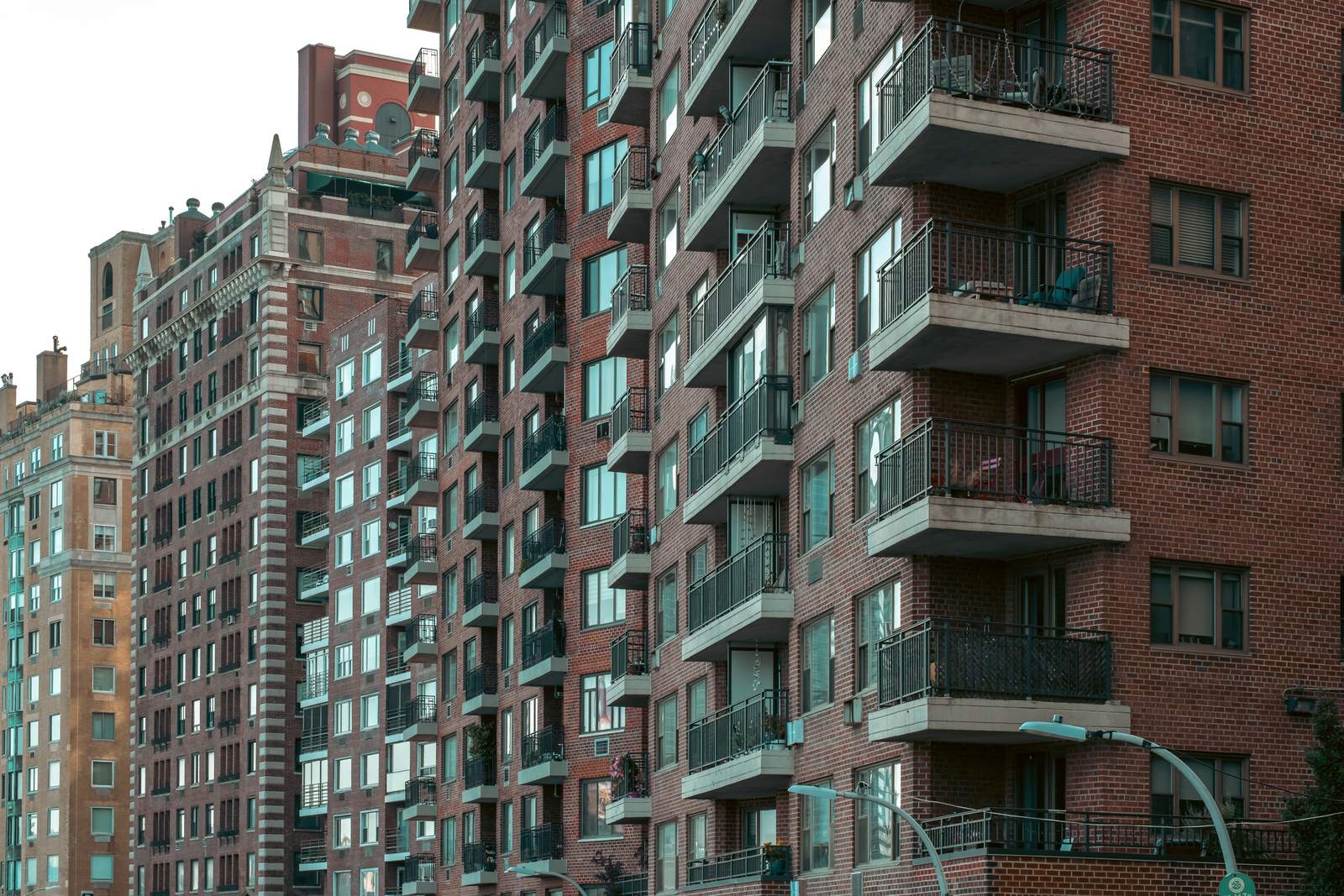
Stock photos of New York apartment buildings. Photos: Arif Kemal Köroğlu, Brett A, Darya Sannikova, Jan van der Wolf, Karl Solano, Yusuf Çelik on Pexels.
The short version
- Under Local Law 58 of 2026, a board has 15 days to confirm it received your buyer’s package and 45 days after that to decide.
- Boards may still turn a buyer down without explaining why, because the bill that would require reasons (Int 0774-2026) has not left committee.
- Any flip tax has to be written into your building’s governing documents before you sell, or the board cannot collect it.
- This year’s co-op medians were $320,000 in Midwood, $290,000 in Madison, $230,000 in Marine Park and $271,890 in Sheepshead Bay.
On this page
What co-ops sold for in Midwood, Madison, Marine Park and Sheepshead Bay in 2026
We pulled every apartment sale the city recorded as a co-op in these neighborhoods from January through September, along with the same months of last year, to see where prices sit.
Median co-op sale price, 2026
Co-op apartment sales recorded January 1 to September 30, 2026, at $100,000 or more.
NYC Department of Finance rolling sales, Brooklyn, file dated October 13, 2026.
| Neighborhood | Co-op sales, 2026 | Median, 2026 | Median, 2025 | Co-ops as a share of all sales |
|---|---|---|---|---|
| Midwood | 57 | $320,000 | $345,000 | 34.3% |
| Madison | 20 | $290,000 | $293,000 | 14.7% |
| Marine Park | 13 | $230,000 | $220,000 | 8.6% |
| Sheepshead Bay | 110 | $271,890 | $280,000 | 38.7% |
| Gravesend | 31 | $385,000 | $374,250 | 14.9% |
| All of Brooklyn | 1,553 | $463,000 | $473,500 | 19.7% |
NYC Department of Finance: rolling sales file dated October 13, 2026 for 2026, annual sales data for 2025. Sales recorded January 1 to September 30 each year, co-op building classes only, at $100,000 or more. Marine Park and Madison have few co-op sales, so one or two sales can move the median.
In Midwood and Sheepshead Bay, co-ops make up a third or more of all sales, while in Marine Park, where most homes are houses, they are a small slice. In every one of these neighborhoods, though, co-ops sold well under the Brooklyn co-op median.
How to sell your co-op in Brooklyn, step by step
- Read your governing documents first. Your proprietary lease, bylaws and house rules decide any transfer fee, the sublet rules and what the board will ask of a buyer, and the managing agent can send you the current board application.
- Price it on apartment sales, not house sales. Recent sales in your own building and the ones around it are the best guide, and since buyers weigh the monthly maintenance alongside the price, a real estate agent or broker who sells coops locally can help you read both.
- Accept an offer from a buyer who can pass, then sign the contract of sale. Boards look closely at finances, so a buyer who looks thin on paper can cost you weeks.
- The buyer submits the board package, which pairs the building’s own forms with financial papers; a law firm that works with co-ops lists tax returns, bank statements, a personal financial statement, pay stubs and reference letters as typical.
- The board members review it, often with a board interview, and give their answer within the new legal deadlines.
- Close. On the closing date your shares and lease transfer to the buyer, and the building’s fee and the taxes are paid.
The board clock under Local Law 58, for buildings of 10 or more units
Package in
Your buyer sends the board package, usually through the managing agent.
Up to 15 days
The board must confirm in writing what it received, or the package counts as complete.
Up to 45 days
The board says yes, yes with conditions, or no. It may extend once by up to 14 days.
Closing
With consent in hand, the shares and proprietary lease transfer at closing.
NYC Local Law 58 of 2026, for applications made on or after July 28, 2026. The clock pauses during a posted summer break.
Co-op board approval and the new NYC deadlines
A coop is not residential real estate in the usual sense. The New York Attorney General describes it this way: a buyer buys shares in a corporation, the shares are tied to one apartment, and the shares come with a long-term proprietary lease. That is why the corporation, through its board, gets a say in who buys, even in a sale by owner.
For years a board could sit on an application as long as it liked, until the City Council passed Local Law 58 of 2026 over the mayor’s veto on January 29, 2026. For applications made on or after July 28, 2026, the law works like this:
- The board must send a written acknowledgment of what it received within 15 days. If it does not, the application counts as complete on the day the acknowledgment was due.
- It must say yes, yes with conditions, or no within 45 days of a complete application. It can extend once by up to 14 days without the buyer’s consent.
- The clock pauses during a posted July or August summer break.
- Fines run from $1,000 for a first violation up to $2,000 for repeat ones.
- Buildings with fewer than 10 units, and some government-supervised co-ops, are not covered.
Outside expert, not affiliated with The Behfar Team
This is a change that boards are paying attention to,
Peter Massa, a partner in the real estate practice at Fox Rothschild, speaking to Brick Underground in February 2026 about the new deadlines.
The law does not make a board explain a rejection, and whether it should is an argument that has run for years, with sincere people on both sides.
Outside view, for reasons
It’s not like a few co-ops are saying we won’t tell you. Whenever somebody is turned down, it’s industry policy not to let them know why, and that makes it very difficult to assess whether discrimination is going on,
Craig Gurian, an attorney and spokesperson for groups backing a disclosure bill, speaking to Gothamist in December 2025.
Outside view, against
We would no longer be able to have that flexibility because in order to avoid claims of discrimination we would have to be 100% consistent in the way we treated every applicant
Warren Schreiber, president of a Queens co-op board and co-president of the Presidents Co-op and Condo Council, in Habitat magazine, January 2025.
Whichever side wins that argument, your best protection against a turndown is a buyer whose finances clearly fit the building’s rules and a complete, tidy package, which is where a good agent earns the fee.
What is a flip tax, and how much is it in NYC?
A flip tax is a fee your building, not the city or state, charges when you sell, and it only counts if it is written into the proprietary lease, the offering plan or a properly approved amendment.
The rule goes back to 1985, when New York’s highest court, in Fe Bland v. Two Trees Management, struck down transfer fees a board had added on its own; the legislature then changed the Business Corporation Law to allow a fee that the building’s documents provide for.
Outside expert, not affiliated with The Behfar Team
If the flip tax is not in place when you sell, you cannot charge it,
Andrew B. Freedland, a partner at Herrick Feinstein, answering a reader in The New York Times in November 2024.
Nobody publishes building-by-building figures, so the sizes you will see are estimates, and they disagree: experts told Brick Underground most buildings charge about 1 to 2 percent of the sale price, while Bonnie Reid Berkow, a co-op attorney at Adam Leitman Bailey, puts the range at one to five percent of gross sales price, with two or three percent being the most common.
On a typical Midwood apartment at this year’s $320,000 median, a 2% fee comes to $6,400 and a 3% fee to $9,600, though some buildings charge a flat amount or a set sum per share instead. Who pays is negotiable, and in practice it is usually the seller.
Outside expert, not affiliated with The Behfar Team
The hardest part of implementing or amending a flip tax is getting shareholder approval,
Bonnie Reid Berkow, a real estate attorney at Adam Leitman Bailey, P.C., who represents co-ops and condos in New York City, on why flip taxes are hard to change.
Your buyer’s mortgage, the appraisal and the closing papers
Most buyers borrow, which brings a lender into the deal. The lender will usually order an appraisal of the apartment and ask about the building’s finances, and because a low appraisal can force a price talk, a well-priced listing helps here too. Some buildings also cap how much of the price a buyer may finance, so check those rules before accepting an offer that leans on a large loan.
Start looking for your own papers now. At closing you hand over your original stock certificate and proprietary lease. If you still have a loan, your lender usually holds them, and the payoff at closing releases them. If they are lost, your attorney will need time to deal with that.
Closing costs for a co-op seller in Brooklyn
Co-op sellers pay the same two transfer taxes as house sellers. The city taxes transfers of shares, and the state counts the apartment as residential property.
| Cost | Rate | On a Midwood co-op at $320,000 |
|---|---|---|
| New York State transfer tax | 0.4% | $1,280 |
| New York City transfer tax | 1% up to $500,000 | $3,200 |
| Building transfer fee, if any | Set by your building | $6,400 at 2%, as an example |
| Commission | Negotiated | $16,000 at 5%, as an example |
| Your attorney, managing agent fees, loan payoff | Varies | Ask your attorney and managing agent |
Transfer tax rates: NYS Department of Taxation and Finance and NYC Department of Finance. The 2% flip tax and 5% commission are examples for the math, not quotes.
Why are Sheepshead Bay co-ops cheaper than the rest of Brooklyn?
Someone asked exactly that on r/Brooklyn this February, and the thread ran to 51 comments. The most upvoted answers were short.
From the thread
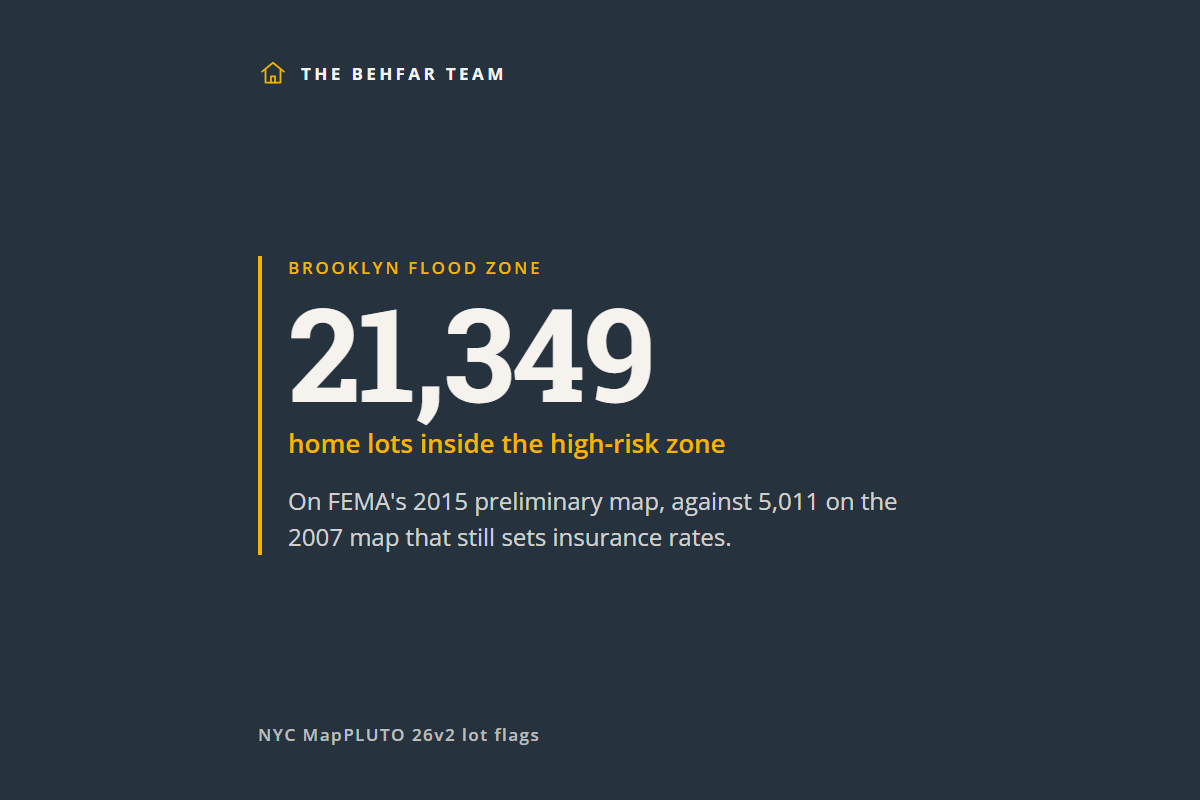
Flood zone. Far from transportation for the most part, far from Manhattan.
A reply on r/Brooklyn. A Sheepshead Bay co-op owner in the same thread added that their maintenance is high, but “so we only pay the maintenance and yes it is high for a co-op, however it does include all utilities and taxes, which I believe many of the co-ops around here do but don’t quote me on that.”
Our sales pull backs up the price gap. Sheepshead Bay had more co-op sales than any other neighborhood in our table this year, 110, at a median of $271,890. That is below Midwood’s $320,000 and far below the Brooklyn median of $463,000.
If you want to sell, the lesson in that thread is useful anywhere: buyers compare the monthly maintenance, what it includes, and the building’s flood and commute picture, not only the price.
Where The Behfar Team fits
We list co-ops, condos and houses in Midwood, Madison and Marine Park, from our office at 1524 East 23rd Street. When you list your co-op with us, we help the buyer get the board package right the first time. Every listing gets professional photography, a floor plan and a 3D tour, which helps buyers who want to see the layout before they commit to a board package. Here is everything we do on our seller services page.
Frequently asked questions about selling a co-op in NYC
How long does it take to sell a co-op in NYC?
The board step alone can now take up to 15 days to acknowledge the package and 45 days to decide once it is complete, plus one 14 days extension, for buildings with 10 or more units. Add the time to find a buyer and sign a contract before that, and closing after.
Can a co-op board reject a buyer without a reason?
It can. New York City’s new deadline law still lets a board deny consent without saying why, as long as the reason is not illegal discrimination, and the bill to require written reasons, Int 0774-2026, has not passed.
Who pays the flip tax in NYC?
The seller usually pays it at closing, in the amount your building’s documents set, although the contract of sale can shift it to the buyer.
How much is a flip tax?
Each building sets its own. Published estimates run from about 1 to 2 percent of the sale price to one to five percent of gross sales price, with two or three percent being the most common, and some buildings use a flat fee or a charge per share instead.
Do co-op sellers pay transfer tax?
They do: the city taxes a transfer of co-op shares at 1% up to $500,000 and 1.425% above, the state adds 0.4%, and on a Midwood co-op at the 2026 median of $320,000 the two come to $4,480.
What does a co-op sell for in Midwood?
The median co-op sale in Midwood was $320,000 from January 1 to September 30, 2026, across 57 sales.
Sources
- New York City Council, Local Law 58 of 2026 and Int 0774-2026.
- New York Attorney General, Cooperatives; New York Business Corporation Law section 501; Fe Bland v. Two Trees Management Co., 66 N.Y.2d 556.
- Brick Underground, co-op boards’ new timeline and flip tax trends; Habitat magazine, co-op disclosure legislation; Herrick Feinstein, flip taxes; Adam Leitman Bailey, changing a flip tax.
- NYC Department of Finance, Real Property Transfer Tax and rolling sales data; NYS Department of Taxation and Finance, real estate transfer tax.
From The Behfar Team
We work from our office at 1524 East 23rd Street in Midwood and have closed 494 buyer and seller transactions. Our 145 Google reviews average 4.9 stars, and our agents speak six languages.
What is your co-op worth this year?
We will look at recent sales in your building and the co-ops around it, and give you a price you can plan around. You can also call the office at 347-988-2526.
Rules here come from New York City law, New York State law and the New York State and City tax departments, current as of October 2026. This is general information, not legal advice. Your building’s documents and your attorney have the final word on your sale.