
We had a Sunday morning showing on East 13th Street between Avenue J and Avenue K last spring, inside the Midwood eruv, and by Tuesday two observant families had already written offers because both had verified the eruv status with their shul before walking through the door. Six blocks south the same week we listed an almost identical house, just outside the perimeter. That one took 67 days and the buyer ended up being a non-observant family from outside the neighborhood. The closing-table difference between the two homes worked out to about $40K, and the only meaningful difference between them was which side of the eruv line they fell on.

What an eruv is, in plain terms
For anyone who hasn’t had to think about this before, the practical version is straightforward enough. On a Saturday morning an observant family walking out of their house can or can’t have keys in their pocket depending on whether the block sits inside the eruv boundary, since traditional Jewish law restricts carrying between private and public spaces on Shabbos. Inside the boundary the rule treats the area as a single shared space, which is what makes carrying keys or pushing a stroller permissible. Outside it the same actions are off-limits until sundown Saturday, which is why a family with small kids or someone who likes to walk to friends for a Shabbos meal will check the eruv status on their block before they sign any contract.
The boundary itself is a stitched-together perimeter using existing utility wires and poles, and it gets maintained by local rabbinical organizations. When a wire comes down or a pole gets replaced the eruv can be down for that Shabbos, so every shul checks the status on Friday afternoon. So when an observant buyer asks whether your house is inside the eruv, what they’re really asking is whether the eruv is up that week, and the answer to that depends on the maintenance crew as much as on the boundary map.
What’s roughly covered in southern Brooklyn
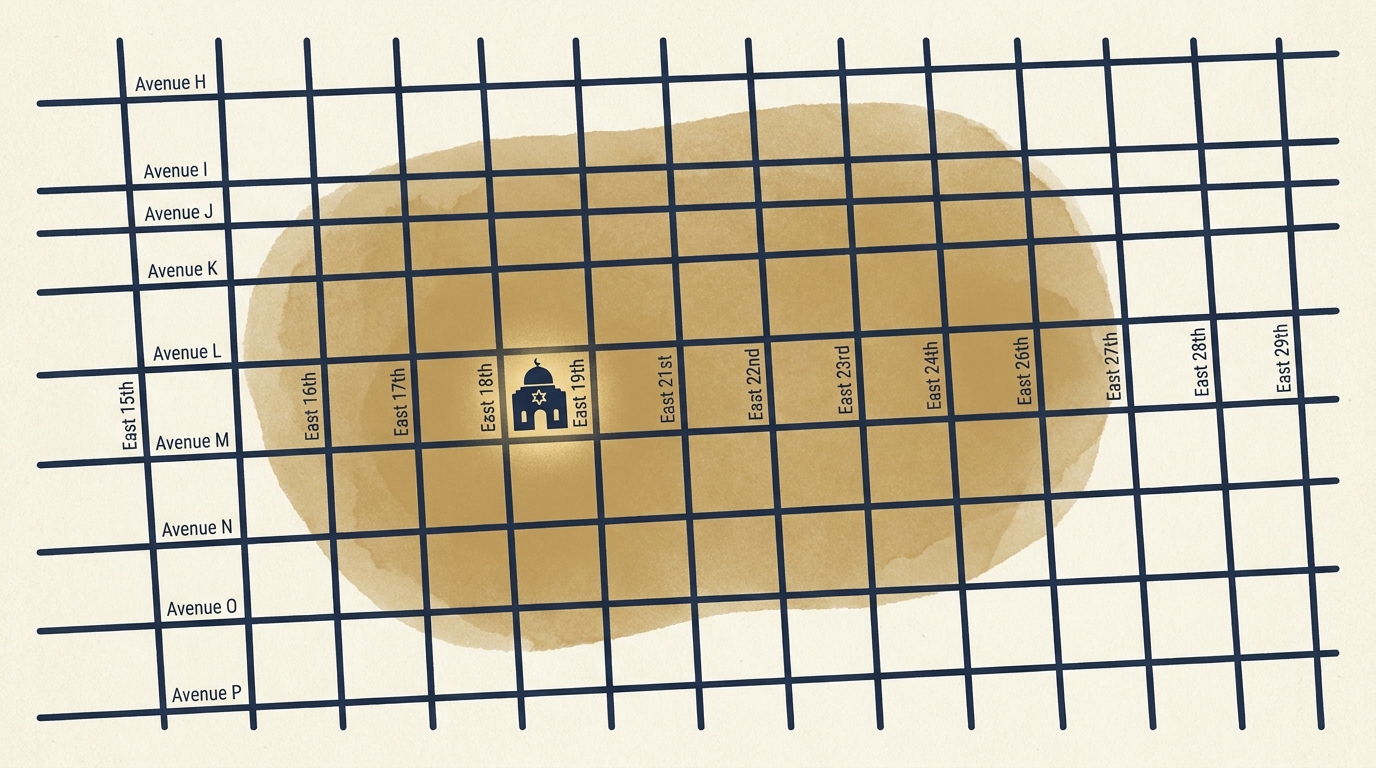
The Midwood eruv runs through most of the neighborhood from Avenue H south down to Avenue P, with the east-west spread covering roughly East 7th over to East 23rd. The Flatbush eruv covers most of the observant-family blocks bounded by Ocean Parkway on one side and Coney Island Avenue on the other, with the J through M corridor as the rough north-south extent. Madison overlaps the southern Midwood eruv along its northern blocks, while the southern blocks of Madison may sit outside or right on the edge depending on which year you’re asking about. Marine Park is mostly outside the established perimeters, although a handful of blocks adjacent to Madison or Flatbush have moved in and out of coverage over the years.
Don’t take any of this as gospel for your specific block, since the boundaries shift. Verify before you list a property as eruv-included, because an outdated map costs you both buyer trust and buyer pool size.
Approximate descriptions for orientation. Verify current eruv status with local rabbinical authorities before listing or buying. We don’t certify eruv boundaries.
How to check your block’s status this week
The fastest way to confirm where you stand is to call the nearest shul on a Friday afternoon, since they check every week and most of them will give you the answer over the phone. The next-fastest path is to look at the published map from your local rabbinical organization, since several Brooklyn community groups maintain updated boundary maps with weekly status notes. If your block has been observant-occupied for years and you can see neighbors carrying on Shabbos between your house and the shul down the street, you’re almost certainly inside, although a quick call to confirm before you list is still worth doing.
If you’re listing, save the date and source of your verification because buyers’ agents will ask for it on day one. We attach a copy of the most recent confirmation to our listing materials.
Why this moves both the price and the timeline
An eruv-included home that fits the rest of the observant-family checklist (walkable to a shul, walkable to a school, kosher-friendly kitchen layout) reaches the right buyer pool faster than it reaches the open market. The path is usually through WhatsApp groups and shul announcements before the MLS listing has fully settled, which is how houses end up under contract on day three because the listing got passed around in a school-parent chat the night before.
The premium versus a comparable non-eruv house is real but block-specific. We’ve seen $20K to $50K differences on similar Midwood and Madison stock, while on blocks where most buyers don’t care we’ve seen no difference at all. Run your own numbers with an agent who actually works the community side of the buyer pool, because borough-wide averages don’t capture this.
The other effect is buyer-pool size. A non-observant buyer doesn’t care whether your house is inside the eruv, while an observant buyer absolutely does, so an eruv-included home pulls from both groups. A non-included home pulls from one.
How to market an eruv-included listing
Put “Inside the Midwood eruv” or “Inside the Flatbush eruv” right in the listing description near the top, since burying it on page three loses the click. List the closest shuls and yeshivas by name rather than as a generic “near schools” line, because the community knows the names and they want to see them. Show the outdoor space that supports a sukkah even if the listing photos are taken in February, since a backyard with the right setbacks reads as a feature year-round. If you can run Hebrew-language outreach into community channels alongside the standard MLS and StreetEasy push, the community-channel side often produces the offer before the public-side does. We do both.
How we handle eruv-included listings
We’ve listed inside and outside the Midwood and Flatbush eruvs across many cycles, and our office at 1524 East 23rd Street sits in the middle of it. Karen speaks Hebrew alongside English and Farsi, which means our community-side outreach goes out in the right language without translation friction. We verify eruv status with the local rabbinical sources before listing and we put that verification date in the listing materials, so a buyer’s agent can rely on it without making their own call.
Selling in the Midwood Orthodox community » · Hebrew-speaking real estate agents in Brooklyn · Free home valuation
About The Behfar Team
Karen Behfar (lead agent, Master’s in Psychology) and Aharon Behfar lead The Behfar Team from 1524 East 23rd Street in Midwood, Brooklyn. The team focuses on sellers across Midwood and the surrounding southern Brooklyn neighborhoods, and works with clients in five languages. Recent listings have been averaging roughly 38 days on market when priced from comparable closed sales. Meet the team · Free home valuation · (347) 988-2526.
This guide is informational and reflects The Behfar Team’s observations as of May 2026. Real estate decisions should be made with a licensed New York State real estate professional and, where relevant, a tax or legal advisor. Equal Housing Opportunity.